 |
| Hi there- my name is Stinky! I was quite surprised to find that many of the insects I have photographed in the past two years are actually Stink Bugs in various stages of their life cycle. The following is part of an article copied from www.stinkbugsguide.com "These insects get their name from a foul-smelling liquid that they produce. They use the smell as a defensive mechanism. If a stink bug is mishandled or threatened it can release the liquid from specialized glands. The smell is suppose to prevent the bug from being hurt or eaten. The liquid is also released when the bugs are squashed. Though the smell is strong, it usually can be removed with simple soap and water. As with many other bugs, stink bugs go through a life cycle. Female stink bugs lay eggs on the under side of leaves. Once the eggs hatch, they are called stink bug nymphs. The nymphs look a lot like the adults, but are wingless. Finally, after about 4-5 weeks, the bugs become full adults equipped with wings. One female stink bug can produce up to 5,000 bugs in two generations.  There are many different types of stink bugs. Most stink bugs have a brown, green, or gray coloring. These bugs can easily blend into their surroundings to hide from predators. Some stink bugs, such as the Harlequin Bug, have bright coloration to ward off would be predators." |

@maggiezlenz - a photo journal of wild and wonderful thingz...
Friday, 6 January 2012
January 6, 2012


Thursday, 5 January 2012
January 5, 2012
 |
| What's the joke, I wonder? It really looks like it is laughing! This strange little Caterpillar turns out to be of the moth that I posted a photo on 15 Feb 2011, or a pretty close relative. Scopula perlata - I could not find the common name for it . |

Wednesday, 4 January 2012
January 4, 2012
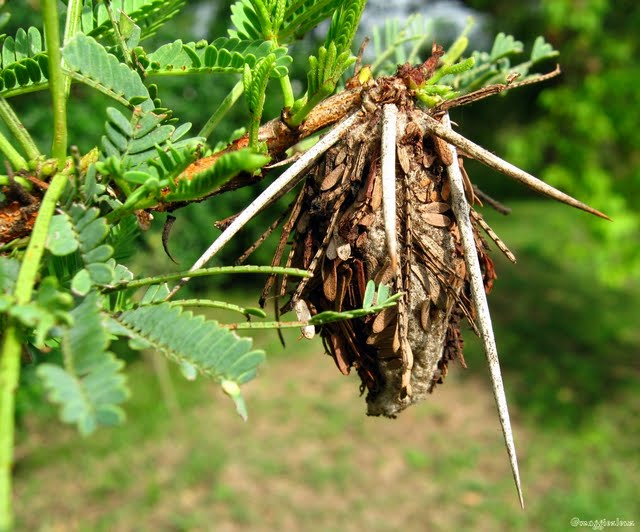 |
| Bag-worm Moth I have never such a large Bag-worm case and decorated with thorns from the host Acacia tree! One wonders how a small insect can chew off a thorn of this size. Wikipedia has some very interesting info and I would like to share it below: "The Bag-worm is a moth that spins its cocoon in its larval life, decorating it with bits of plant material from the trees on which it feeds. When disturbed, the larva will retract its head into its case and hold the front opening closed. Mature larva may remain in the host tree or drag its case nearby before attaching itself for the pupa stage. Newborn larva emerge from the carcass of their mother in her case and are blackish and turn brown to tan as they grow, mottled with black. The heads and thorax develop a yellow tint as they grow to a full length of 24 to 32 mm. Adult males resemble bees, having a 25 mm wingspan with transparent wings and black furry bodies. Adult females are maggot-like with yellowish-white soft bodies 19 to 23 mm long and small tufts of hair near the end of the abdomen. The cream colored eggs are 0.75 mm in diameter. Newborn larva emerge from the bottom of the hanging case and drop down on a strand of silk. The wind often blows the larva to nearby plants where it begins its new case from silk and fecal material before beginning to add leaves and twigs from its host. When mature in mid-August, the larva wraps silk around a branch, hangs from it, and pupates head down. Adult males transform into moths in four weeks to seek out females for mating. The female never leaves the cocoon, requiring that the male mate with her through the open end at the back of the case. She has no eyes, legs, wings, antennae, and can't eat, but she emits a strong pheromone to attract a mate. After her death with hundreds to several thousand eggs still inside, her offspring hatch and pass through her body, pupal shell and case over several months emerging to start their own cases. Later, her pupal case can be found, full of the yellow remains of eggshells. The bagworm has a voracious appetite and is considered a serious pest. Host trees develop damaged foliage that will kill the tree if left unchecked. If caught early enough in an infestation, the cases from the previous year can be picked off by hand before the eggs hatch." |
Subscribe to:
Posts (Atom)